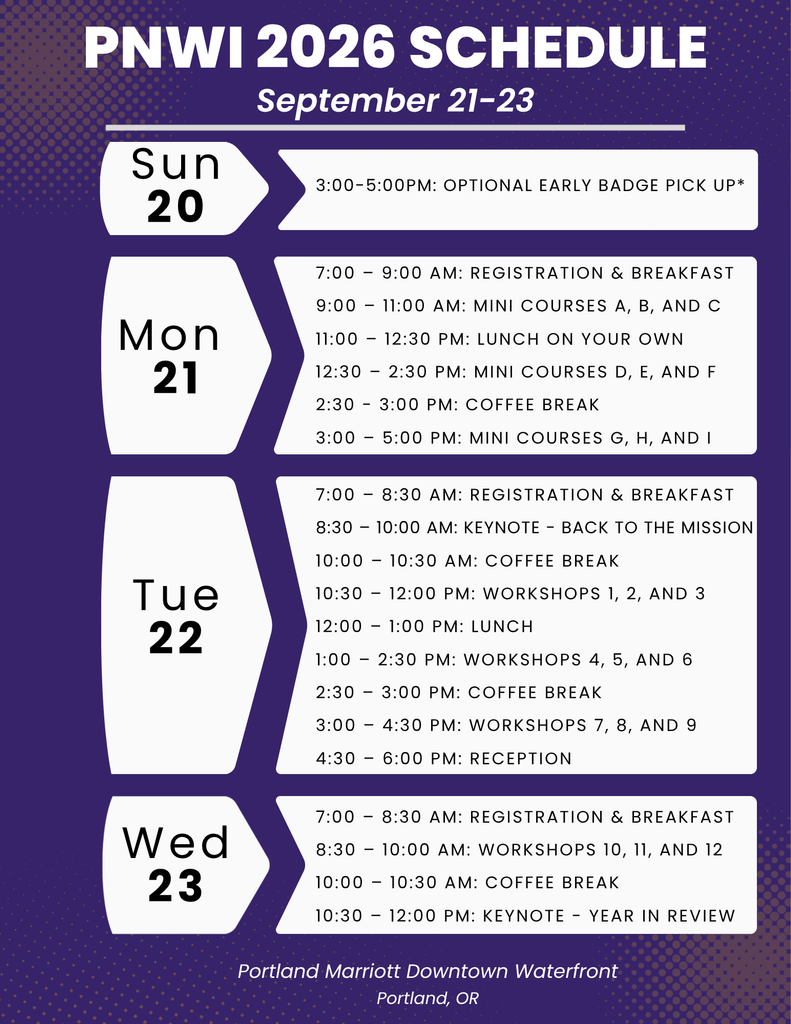
*To help minimize crowding and wait times during registration, we will be offering an opportunity for early badge pick up on Sunday from 3-5pm. While this is not mandatory, we encourage attendees to utilize this time so they can go straight to their sessions once the conference begins.
Mini Courses (Monday)
MC-A: Promoting Independence: Aiming Higher Than 1:1 Paraprofessional Support – presented by Patrick Mulick
If our students are going to be more independent as adults, then we need to be building up their independence now. However, many districts struggle with an over-reliance on 1:1 paraprofessionals to support students with disabilities. This dynamic and content-rich course offers a practical blueprint for building sustainable, inclusive support systems that value student autonomy. Learn how to implement targeted structures and strategies that promote independence and reduce the dependence on 1:1 adults.
MC-B: From Absence to Action: Addressing Chronic Absenteeism and School Refusal under IDEA and Section 504 – presented by Elizabeth Polay
This practical, case-driven presentation explores the intersection of chronic absenteeism, school refusal, and the IDEA with real-world examples of what districts got right, where they went wrong, and why. Attendees will leave with practical strategies for turning attendance concerns into appropriate action while avoiding costly legal missteps.
MC-C: From Evaluation to Due Process: Defensible Practices in School Psychology and Special Education Decision-Making – presented by Andrew Johson
Psychoeducational evaluations are foundational to special education decision-making under the Individuals with Disabilities Education Act—and among the most frequently challenged in due process hearings. This session explores how evaluations are examined, deconstructed, and defended under legal scrutiny, with a focus on the gaps that often lead to disputes, including misalignment between referral concerns and assessment methods, weak integration of data, and unclear links to eligibility and IEP decisions.
Drawing on real-world practice, participants will gain insight into how attorneys and expert witnesses analyze evaluation reports, as well as practical strategies to strengthen defensibility. Emphasis is placed on aligned assessment planning, clear and legally grounded report writing, and thorough documentation of team-based decision-making.
Designed for school psychologists, administrators, attorneys, and special education leaders, this presentation provides actionable guidance to improve evaluation quality, reduce disputes, and ensure decisions are both educationally meaningful and legally sound.
MC-D: Special Education Jeopardy: Acronyms, Deadlines, and Nuts & Bolts – presented by Miller Nash LLP
Ready for a round of Jeopardy? Come join our team in this session as we embark on a game show-style presentation to analyze the labyrinth of special education regulatory requirements in the areas of deadlines, prior written notice events, and other nuts and bolts of special education.
MC-E: Navigating the Complex Word of Child Find Compliance – presented by Jan Tomsky
Over the past several years, virtually every state has experienced a significant spike in due process hearings alleging that school districts have failed to carry out their obligation to identify, locate and evaluate children with disabilities. This session takes a fresh look at the scope of child find responsibilities through an overview of statutes, regulations, guidance, in-depth case examples, and practical pointers. We’ll cover events that can trigger the duty to assess, the potential consequences of failing to meet child find requirements, child find duties to private school students with disabilities, and much more.
MC-F: Appropriately Addressing Anxiety and Depression – presented by Jonathan Read
Studies have shown that students with disabilities are more likely than their nondisabled peers to experience anxiety, depression, and other mental health issues. Contributing factors can include behavioral issues, academic struggles, and social difficulties. In addition, since the end of the COVID pandemic, due process filings involving students with anxiety and/or depression have increased significantly. Through an in-depth look at legal standards and selected case law decisions, this session focus on some of the most problematic issues for IEP teams—identifying, determining eligibility and providing appropriate goals, services and placements—for this group of students.
MC-G: Who Is the Client? Ethical Complexity in Representing Students, Parents, and Families – presented by Kaitlin Leifur-Masterson
Representing students and families in education disputes presents unique ethical challenges that rarely fit neatly within traditional attorney-client frameworks and ethical tension for school districts making placement decisions for IEPs.
This session explores difficult questions surrounding client identity, decision-making authority, confidentiality, and conflicts when representing minors, transition-age students, students with disabilities, and families navigating complex school disputes. Topics include parent-child conflicts, supported decision-making, FERPA and HIPAA considerations, divorce and co-parenting dynamics, joint representation pitfalls, and navigating situations where a student’s expressed wishes diverge from IEP team decisions. Through practical scenarios and real-world examples, participants will examine how to ethically navigate competing interests while maintaining professional obligations in increasingly complex educational advocacy settings.
MC-H: Regular Ed, 504 & IDEA: How Do They Work Together? – presented by David Richards
Understanding the relationship among regular education, Section 504 and special education is a key piece of legal compliance. The President’s Commission Report on Excellence in Special Education wrote years ago that all kids are regular ed kids first. In this lively session, Dave will explain the interesting dynamic created by this principle, and how these laws fit together, interact, and support each other. Further, we’ll examine the differing approaches of Section 504 and IDEA and the modern dynamics of child find in Section 504 for students in RtI and on health plans. While there is a logic and pattern to the relationship among Regular Education, Section 504 & IDEA, that logic does not preclude some areas of complexity. We’ll also examine a few areas of complexity in the relationship.
Access to Specially Designed Instruction After Revocation of IDEA Consent. While it’s clear that all IDEA-eligible students have Section 504 rights, can students get an IDEA IEP simultaneously with a Section 504 Plan? What happens when parents refuse consent for special education services or revoke consent after services have been provided? What is Section 504’s FAPE obligation? Does the 504 Committee have to include specially designed instruction in the 504 Plan since the IEP Team determined it necessary for FAPE under IDEA? Can or should the 504 Committee provide specially designed instruction where consent for such has been denied or revoked under IDEA?
Responsibility for Grade-Level Curriculum. Regular education students are expected to master the grade-level curriculum. Special education students are required to receive maximum exposure to grade level curriculum, recognizing that for some students, less than grade level curriculum exposure is appropriate for the student to receive educational benefit. What about the Section 504 kids in the middle? Can Section 504 reduce the student’s exposure to, and responsibility for, grade level curriculum AND still provide the student opportunity for equal participation and benefit compared to nondisabled peers? We’ll examine some confusing guidance from OCR on the issue.
When ADA/504 Equal Access Collide with IDEA FAPE. If a regular education student has the opportunity to choose to attend a class, program or campus, the IDEA-eligible student has the same right under Section 504/ADA. But what happens when the parent or student choice would result in a placement where the required IDEA FAPE cannot be provided?
MC-I: Manifestation Determination Workshop: Operationalizing the MDR Requirement in Real-Life Situations – presented by Jose Martín
The requirement for a manifestation determination review (MDR) is the primary protection IDEA provides against discriminatory disciplinary changes in placement. This session will focus on how teams can conduct effective and legally compliant MDRs by means of team-based discussion of real-life scenarios. In addition to reviewing the why, when, and how of the requirement, the scenarios will explore various complexities that may arise in MDRs, such as impulsivity arguments, parent submission of private diagnoses of additional disabilities in the midst of discipline procedures, options for addressing MDRs for students pending IDEA evaluation, addressing past patterns of student behaviors, situations of failure to implement BIPs, dealing with non-qualifying disabilities in addition to those rendering the student IDEA-eligible, and potential procedural issues, such as ensuring proper data bases for MDRs and helpful documentation of the rationale for MDR findings in district forms. Recent MDR caselaw will help show how teams should and should not handle some of the preceding challenges.
Workshops (Tuesday and Wednesday)
Keynote General Session: Back to the Mission: Putting Students First and Advancing Inclusive Outcomes Together – presented by Glenna Wright-Gallo
At the heart of every educational decision is a simple question: What will help students thrive? As schools work to improve outcomes for students with disabilities, success depends on more than policies, programs, procedures, or compliance. It requires a commitment to changing systems, strengthening partnerships, and creating learning environments where every student has access to meaningful opportunities, high expectations, and a true sense of belonging.
In this interactive opening keynote, Glenna Wright-Gallo will explore how schools, families, and communities can work together to move beyond compliance and focus on the actions that lead to better outcomes for students. Drawing on her experience as an educator, state leader, national policy advisor, and person with a disability, she will share lessons learned from advancing inclusive educational practices across schools, districts, and states.
Participants will examine how recent federal guidance on inclusive educational practices reinforces the importance of collaboration, shared responsibility, and continuous improvement. Through stories, practical examples, and audience engagement, attendees will explore how strong family-school partnerships, integrated systems of support, and inclusive practices can improve academic achievement, engagement, independence, and postsecondary success.
This session will challenge participants to look beyond whether systems meet procedural requirements and instead ask whether those systems are producing the outcomes students and families deserve. Together, participants will explore how to align policy, practice, and leadership around a common purpose: ensuring every student has access to the support, opportunities, and relationships needed to succeed.
As PNWI continues its commitment to putting students first, this keynote will set the stage for the conference by focusing on what matters most, creating schools and systems that deliver meaningful results for students and families.
Participants will:
- Examine how strong partnerships among families, educators, and school leaders contribute to improved student outcomes.
- Explore strategies for moving beyond procedural compliance to systems that promote belonging, access, and achievement.
- Identify actions that strengthen collaboration across general education, special education, and related services.
- Reflect on how leadership, policy, and practice can work together to improve outcomes for students with disabilities.
- Consider how federal and state guidance can support local efforts to create more inclusive and effective educational systems.
WS 1: The 101 on Section 504 – presented by Betsey Helfrich
Join special education attorney, Betsey Helfrich, to go back to the basics of Section 504 of the Rehabilitation Act of 1973. From referral to drafting a solid plan to the special rules surrounding student discipline, this fast paced and engaging presentation will answer your biggest questions and help refine your understanding of Section 504 and your school’s practices and policies.
WS 2: Short Staffed, Still Compliant: Navigating Staffing Challenges under the IDEA – presented by Elizabeth Polay
Staffing shortages are creating real challenges for school districts—but obligations under the IDEA don’t simply pause when positions go unfilled. Join this session for a practical, case-driven look at how districts can navigate vacancies, substitutes, leaves, strikes, and other staffing disruptions without losing sight of their obligations to provide FAPE and implement IEPs. We’ll explore the mistakes that can turn a staffing problem into a legal problem—and, more importantly, the strategies districts can use to keep services moving, minimize risk, and stay compliant when the right people aren’t available.
WS 3: From Accommodation to Autonomy: Rethinking Assistive Technology Across School, Work, and Life – presented by Bryce Johnson
Assistive technology is often treated as an accommodation students use in school. But for disabled students, it can be much more than that: a lifelong vocational skill that supports autonomy, self-advocacy, identity, and participation across school, work, play, and life.
In this session, Bryce Johnson, co-founder of the Microsoft Inclusive Tech Lab, will explore how schools can help students move from receiving accommodations to understanding, personalizing, explaining, troubleshooting, and carrying their own access systems into adulthood.
We will also bring a remote Microsoft Inclusive Tech Lab experience: a hands-on demonstration environment where participants can engage with inclusive technology scenarios, adaptive input, assistive tools, and emerging AI-supported experiences. The goal is to connect policy, compliance, implementation, and lived experience through practical examples that support real student agency.
WS 4: Legal Aspects of Working with Outside Professionals – presented by Betsey Helfrich
From working with advocates, behavior specialists, therapists and other outside entities, this presentation will cover the ins and outs to develop legal, ethical and best practice implications for school partnerships with outside professionals.
WS 5: Is Your School District Prepared to Meet Students’ AT Needs? New Research on What It Takes to Deliver Effective AT Supports – presented by Lesley Rytel and Grace Clark
Despite federal requirements to consider assistive technology (AT) in the IEP process, school-based AT implementation, especially for communication through AAC, remains inconsistent and strongly shaped by whether a district has the infrastructure to back it up. This session presents new research findings examining how AT staffing levels and district processes shape implementation outcomes across districts. We will translate those findings into a clear framework for evaluating your district’s AT systems and strengthening the processes needed to support AT consideration, provision, and use.
WS 6: Managing the Manifestation Determination – presented by Jan Tomsky
The numerous legal rules governing when and how to conduct appropriate manifestation determinations (“MDs”) continue to cause confusion and create challenges for school districts. In addition to a refresher on all of the legal procedures and timelines for conducting an MD review, this session highlights the most common MD pitfalls for districts, provides solutions to those problems and offers numerous practical lessons and tips learned from recent case law to help avoid unnecessary conflicts and costly litigation.
WS 7: Parent Participation Done Right – presented by Jonathan Read
School districts have encountered many legal challenges in making sure that parents have the opportunity to participate in the development and implementation of their child’s IEP. Scheduling IEP meetings, ensuring parents understand the proceedings, holding meetings without parents, providing alternate means of participation, and making team decisions are all issues that school districts must approach carefully so that parents of students with disabilities are partners in the IEP process. Look with us at the statutes, regulations and cases addressing these topics and get practical tips on how to comply with the myriad of legal requirements.
WS 8: Yes We Can: Strategies to Reduce Restraint and Eliminate Seclusion – presented by Patrick Mulick
While the use of restraint and seclusion can have a lifelong impact on students, reducing these practices requires a collaborative commitment to change. Drawing from systemic transformations in the Auburn School District, Patrick Mulick demonstrates how multi-disciplinary teaming, tiered behavioral supports, and the strategic utilization of district experts can prevent and minimize behavioral escalations. This session equips attendees with actionable, proactive strategies to more effectively support students with complex behavioral needs today.
WS 9: Section 504 & Doctors – presented by David Richards
Doctors can provide important information to Section 504 Committees as they make determinations of eligibility and need for services. Unfortunately, mythology persists among educators about the necessity for and weight to be given medical data and a doctor’s communications during evaluation and placement. In this lively session, we’ll debunk the myth that a doctor’s diagnosis is necessary for eligibility and talk about the financial burden placed on the school that takes such a position (and the possible negative impact on child find). We will analyze OCR’s long-standing recognition of the 504 Committee’s ability to determine physical or mental impairments in the absence of diagnosis and examine situations where schools should have looked to medical data but did not. Other topics for discussion include determining the weight to be given medical data (i.e., when is the doctor opining on educational issues or other matters beyond her medical expertise), what happens when the school is denied access to the medical data it needs to make decisions, OCR’s concerns with respect to parents pursuing evaluation data at their own expense, OCR’s guidance on the presumption of eligibility created by the rare top-shelf medical diagnoses of ADHD, and related issues.
WS 10: Parents’ Rights in Special Education with an Eye on the Increasing Trend – presented by Miller Nash LLP
Close watchers of education trends observe that in recent years both the Executive Branch and courts interpreting state and federal legislation are increasingly recognizing a wider scope of rights for parents of all students. This session will explore general trends in parental rights and will examine the additional and more specific rights of parents of students who receive special education services.
WS 11: Widgets and Gizmos: Existing and Emerging Legal Issues in Assistive Tech Under IDEA – presented by Jose Martín
Technology continues to play an increasingly large role in education, including that of students with disabilities. Thus, IDEA requires periodic consideration of each student’s potential need for assistive technology (AT) devices and services. This session addresses key issues in IDEA’s AT requirement, from annual consideration in IEP meetings to factors in determining the need for stand-alone AT evaluations, common practices in AT evaluations, choice of AT devices, relevant factors in selecting devices, issues in implementing AT devices within the context of the IEP, maintenance of devices, parent-provided devices, liability issues for broken devices, AT services and ATD device training, incorporating use of AT devices in IEPs, and issues that commonly arise with laptop computers and tablet devices, calculators, use of AT outside of school, and modern robots and tracking devices, among other subtopics. In addition, the session will address the law’s partial exclusion of personally prescribed devices, medical equipment, and surgically implanted devices, such as cochlear implants. Legal cases will serve to illustrate how the legal concepts involving AT and services play out in real-life situations.
WS 12: When Rights Collide: Student Disability, Employee Safety, and the Limits of School Exclusion – presented by Alex Hagel and Rachel Sugar
Schools increasingly face difficult questions when student behavior implicates both disability protections and workplace safety concerns. This session examines the growing tension between IDEA’s mandate to educate students with disabilities in the least restrictive environment, employees’ legitimate interests in physical and psychological safety, and districts’ legal obligations to both. Using recent litigation involving anti-harassment protection orders and school-based disability conduct as a framework, participants will explore where educational processes end and judicial intervention begins, how districts should respond when safety concerns persist after manifestation determinations, and practical approaches for balancing competing rights while minimizing legal risk. Attendees will leave with concrete strategies for navigating high-conflict situations without sacrificing either safety or educational access.
This session will include discussion of a recent Division II case examining whether civil anti-harassment orders can or should function as a mechanism for excluding students with disabilities from public schools.
Keynote General Session: Special Education Law Year in Review – presented by Jan Tomsky and Jonathan Read
In this fast-paced session, school attorneys Jonathan Read and Jan Tomsky highlight key judicial decisions from the past 12 months to illustrate a variety of compliance conundrums faced by public school districts—where they went right and where they went wrong. Our speakers also discuss practical pointers that can be gleaned from each decision to help special education administrators and IEP teams make legally sound decisions and assist in avoiding costly litigation.